
Willacy County Court Records After Arrest
Court records after a jail arrest in Willacy County are created after the booking event begins to move through the criminal case process. The arresting officer may bring the person to jail, but a prosecutor decides what charge is filed in court. That filing can be a complaint, information, or indictment, depending on the case type and stage. Once filed, the case record is maintained by the appropriate clerk rather than by the jail.
The custody side and the court side should not be merged. The Willacy County jail inmate records path is used for current custody, booking status, bond questions, and release checks. The court record shows filed charges, case events, settings, judgments, and orders. Booking photos and public photo limits are a separate issue, handled through Willacy County jail mugshots information.
Find Willacy County Court Records
The Willacy County District Clerk page for Isabel Adame is the key source for district court records after a jail arrest. The office is at 576 W. Main Ave. Room #102, Raymondville, TX 78580. The phone number is (956) 689-2532, and the fax number is (956) 689-5713. The district clerk notice says the public website can be used to view filings, but documents are not viewable through that site. For copies, call the office.
The linked LGS Online Records Search portal is the public portal named by the district clerk. Research did not fully expose the search controls, so exact field labels should not be invented. Treat it as a case-index starting point, then call the clerk if the search does not show the document, charge, or copy detail needed.
- Open the Willacy County District Clerk page and read the public website notice before searching.
- Use the linked LGS portal for public filing and case-index access where available.
- Search with the most reliable defendant name or case number known from jail, bond, or court paperwork.
- Review the case entry for charge names, case status, hearing events, and clerk notes.
- Call the clerk before relying on an online entry when copies, certification, or a missing document matters.
The official Willacy County District Clerk page explains the copy limitation for public online records.
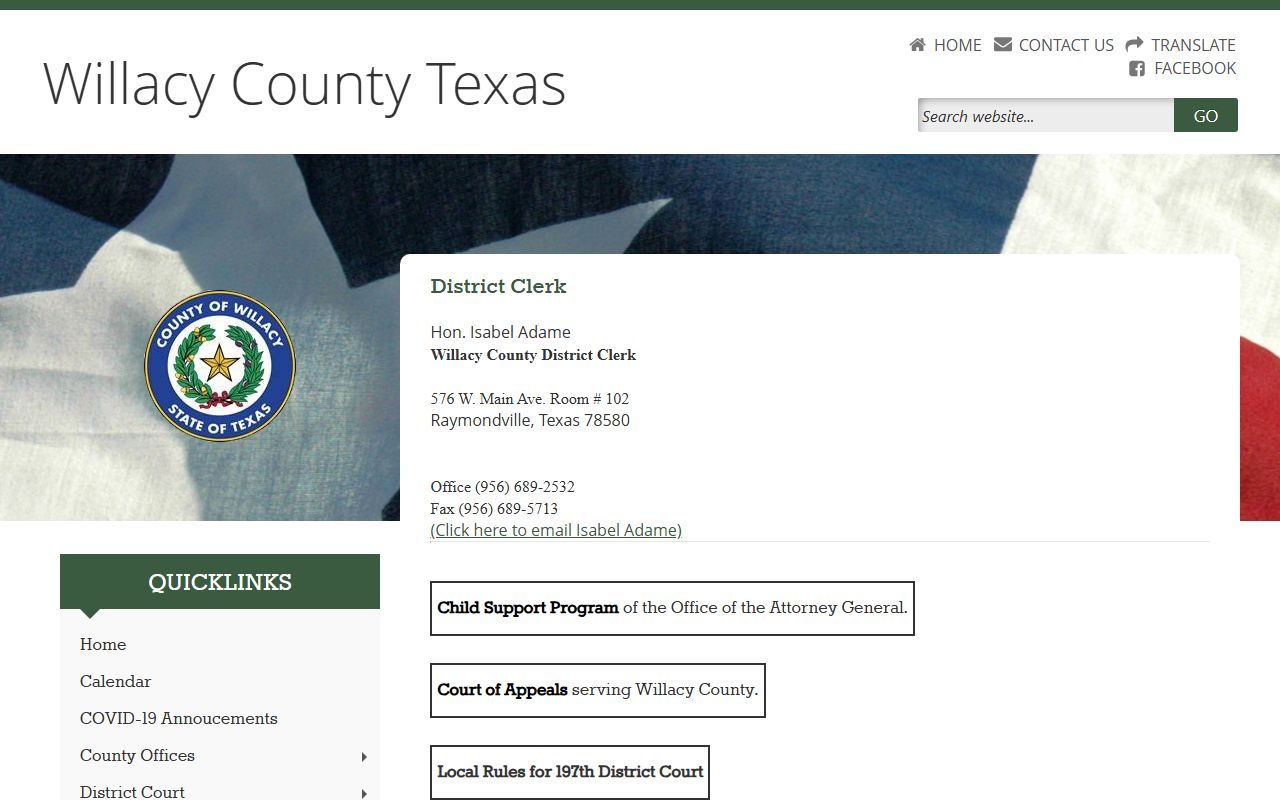
The district clerk source is important because online filing visibility does not mean the public can download every document without contacting the office.
Willacy County Court Offices
Court records after an arrest may involve more than one Willacy County office. The County Clerk, Susana R. Garza, is at 576 W. Main Ave. Room #153, Raymondville, TX 78580. The phone number is (956) 689-2710, the fax number is (956) 689-9849, and posted hours are Monday through Friday from 8:00 a.m. to 12:00 p.m. and 1:00 p.m. to 5:00 p.m. The county clerk page also links court order material, including nondisclosure resources.
The District Attorney and County Attorney page lists Annette C. Hinojosa at 576 W. Main Ave. Room #133, Raymondville, TX 78580. The phone number is (956) 689-2164, and the fax number is (956) 689-5280. That office is not the custodian for every court record, but it is central to the charging decision that turns an arrest into a filed court case.
District Clerk
Isabel Adame
576 W. Main Ave. Room #102
Raymondville, TX 78580
(956) 689-2532
County Clerk
Susana R. Garza
576 W. Main Ave. Room #153
Raymondville, TX 78580
(956) 689-2710
District Attorney and County Attorney
Annette C. Hinojosa
576 W. Main Ave. Room #133
Raymondville, TX 78580
(956) 689-2164
Charges After Willacy County Arrest
After a Willacy County arrest, the first jail entry may list the charge used at booking. The court record begins when a charging document is filed. A charging document is the written accusation that opens or advances the criminal case. It may not match the first booking language word for word because prosecutors can screen evidence, change the charge level, decline a count, or take a case to a grand jury.
| Document | Who Uses It | What It Does | Common Context |
|---|---|---|---|
| Complaint | Officer, prosecutor, or complainant under court rules | States facts supporting an accusation or probable cause. | Often used early in the case or with misdemeanor matters. |
| Information | Prosecutor | Formally charges an offense without a grand jury indictment when allowed. | Common for misdemeanors and some felony procedure stages. |
| Indictment | Grand jury | Charges a felony after grand jury action. | Used for serious felony prosecution in district court. |
The table is a filing guide, not a prediction. The right document depends on the offense, court, prosecutor review, and Texas criminal procedure.
Willacy County Charge Status
Charge status is one of the most important parts of court records after a jail arrest. A pending charge means the case is still open. A dismissed charge means that count is no longer being pursued in that case. An amended or reduced charge means the accusation changed. A conviction means the charge ended in a guilty finding, a plea accepted by the court, or another final judgment that counts as a conviction.
| Status | What It Means | Why It Matters |
|---|---|---|
| Pending | The charge has been filed and has not reached final disposition. | Future hearings, bond terms, or plea talks may still change the record. |
| Amended | The filed charge was changed by the prosecutor or court process. | The final charge may differ from the booking charge. |
| Reduced | The charge level or offense was lowered. | Penalties, bond, and record meaning may change. |
| Dismissed | The court case or count was ended without a conviction on that charge. | Eligibility for expunction or nondisclosure may need legal review. |
| Convicted | The charge ended in a conviction by plea, verdict, or judgment. | Sentencing, probation, fines, or state custody may follow. |
Bond After Willacy County Arrest
Bond is part of the arrest-to-court path because Texas law requires prompt magistrate warnings after arrest. Article 15.17 of the Texas Code of Criminal Procedure covers the warning process, and Chapter 17 covers bail and bond rules. A magistrate may advise the person of the accusation, rights, and bond conditions. The bond record may appear in jail records, court records, or both.
| Bond Type | How It Works |
|---|---|
| Cash bond | The required amount is paid directly, subject to court and clerk handling rules. |
| Surety bond | A licensed bondsman posts bond for a fee and accepts responsibility under the bond terms. |
| Personal bond | The person signs a promise to appear without paying the full bond amount up front. |
| No-bond hold | The person is not eligible for release on that hold until the court or holding agency acts. |
A detainer or hold can block release even when one Willacy County charge has a bond. Check the jail for current custody status and the clerk for the court case tied to the charge.
Charges Versus Convictions
A charge and a conviction are not the same. A charge is an accusation filed after arrest and prosecutor review. A conviction is a final result based on a plea, verdict, or judgment. Court records after a jail arrest should be read by stage because a person can be arrested, charged, released, dismissed, acquitted, placed on deferred adjudication, or convicted.
| Point of Comparison | Charge | Conviction |
|---|---|---|
| Stage | Accusation after arrest or prosecutor filing. | Final court result on the offense. |
| Proof | Based on probable cause or charging decision. | Based on plea, verdict, or judgment under criminal procedure. |
| Record Meaning | Shows the case was filed or alleged. | Shows the person was found or accepted as guilty for that charge. |
| Can Change | Can be amended, reduced, dismissed, or superseded. | Can be appealed or later affected by court orders, but is not just an accusation. |
Sealed and Expunged Records
Texas record clearing is specific. Expunction under Chapter 55 of the Texas Code of Criminal Procedure can remove eligible arrest records when the legal requirements are met. Nondisclosure can limit public access to certain records without destroying them. The Willacy County Clerk page links court orders of nondisclosure materials, which is a useful local cue for people researching whether public access can be limited after a case ends.
| Point of Comparison | Nondisclosure or Sealed | Expunged |
|---|---|---|
| Public View | Hidden from many public checks, depending on the order. | Removed or treated as not existing for many purposes. |
| Record Custody | Record may still exist for agencies allowed by law. | Agencies may be ordered to destroy or return covered records. |
| Eligibility | Depends on charge, disposition, waiting period, and Texas law. | Often tied to acquittal, dismissal, no charge filed, pardon, or other Chapter 55 grounds. |
| Practical Step | Check clerk resources and seek legal advice if needed. | Use the court process required by Chapter 55. |
Warrants and Court Records
A warrant can be the reason a person is booked into the Willacy County Jail. The jail record may list the warrant or hold, but the court file shows the case events that led to it or followed it. A warrant can come from a new criminal complaint, a failure to appear, a probation matter, or another county or agency. If a person is held on a warrant, ask the jail which agency issued it and whether Willacy County has a local case number.
Warrant data can be limited online. A clerk search may show a case, but not all warrant detail is public. The safest path is to check the court clerk, the prosecuting office when appropriate, and the jail custody record for holds. Do not rely on a stale online entry when surrender, bond, or travel decisions are at stake.
Restricted Willacy County Records
Texas Public Information Act Chapter 552 governs access to many government records, but it does not make every case document or arrest detail public without limits. Active investigative information may be withheld under law. Protected personal information, juvenile records, sealed matters, expunged records, and certain victim or witness details can be restricted or redacted. A clerk may also show that a filing exists while requiring a phone call or office request for copies.
Important: Do not use a casual court or custody search for credit, employment, housing, insurance, or another FCRA-covered decision.